
How to Price Your Home to Sell in Today’s Market
Sarah Roberts, Broker Associate | Mosaic Realty Group
Pricing your home to sell starts with understanding what buyers are comparing it to right now—not simply choosing the number you hope to get.
A strong listing price considers recent comparable sales, homes currently competing for buyers, your home’s condition and features, its location and price range, and what is happening in the local market.
And that last part matters.
The DFW housing market is not one single market. Conditions can look different from one county to another, and even between nearby cities, neighborhoods and price ranges. That is why pricing a home well requires a much closer look than a broad DFW statistic or an online home-value estimate.
What Actually Determines the Right Listing Price?
There is no single formula that can tell every homeowner exactly what to list for.
Instead, pricing usually starts by answering a few important questions.
What have similar homes actually sold for?
Recent comparable sales—or “comps”—help establish what buyers have recently been willing to pay for homes similar to yours.
But proximity alone does not necessarily make another home a good comparable.
The most useful comps may consider factors such as:
Location and neighborhood
Property type
Size and layout
Age
Condition and updates
Lot characteristics
Features such as a pool, garage or additional living space
School district or attendance boundaries when relevant
Timing of the sale
A home that sold nearby can provide useful information without being an exact comparison.
The goal is to understand the differences and how buyers may view them.
What Homes Are You Competing With Right Now?
Recent sales tell us what buyers have already purchased.
Active listings tell us what buyers can choose instead of your home.
That distinction is important.
If a buyer searches within a certain area and price range, they may compare your home with several others currently available. Those homes become part of your competition even if they are not identical to yours.
For sellers, one of the most useful questions is:
If a buyer saw our home and the other available options at this price, how would ours compare?
Price, condition, updates, layout and presentation all become part of that decision.
How Much Does Your Home’s Condition Affect Pricing?
Two homes with similar square footage in the same area do not automatically have the same market value.
One may have an updated kitchen, newer systems and fresh paint. Another may need cosmetic work or have major updates approaching.
That does not necessarily mean you should renovate before selling.
Sometimes cleaning, decluttering, addressing a few repairs or improving presentation may make more sense than completing a major project.
The better question is not simply, “What could we update?”
It is:
Would this improvement meaningfully change how buyers compare the home—or the price they are willing to pay?
That is a decision worth making before spending money simply because you are preparing to sell.
Why Local Market Conditions Matter
A DFW housing headline can provide useful context, but it cannot tell you exactly what your home should be worth.
Market conditions can vary by county, city, ZIP code, neighborhood, price range and property type.
For example, Mosaic’s current local market reporting looks at DFW county data and then narrows the picture to areas such as Denton County and Lewisville ISD. That closer view can reveal differences that disappear when everything is grouped into one large market.
Your pricing strategy should work the same way:
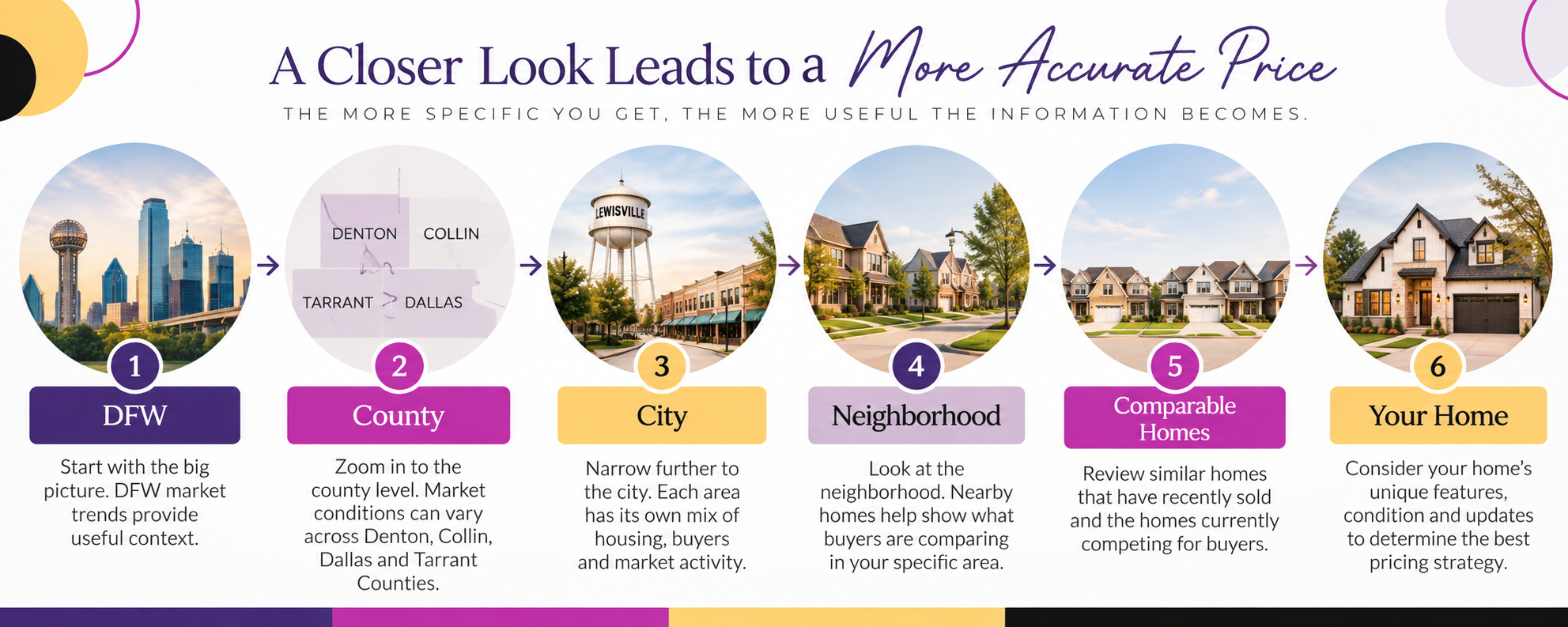
The closer you get to the property itself, the more useful the information becomes.
If you want to understand what is currently happening around your home, you can also review Mosaic’s Local Market Update.
Should You Price High So You Have Room to Negotiate?
This is one of the most common pricing questions.
There is nothing wrong with leaving reasonable room for negotiation when the market and property support it. But deliberately choosing a price well above what comparable homes and current competition support can create another problem: buyers may decide not to engage at all.
Today’s buyers can easily compare listings, price histories, photos, features and competing properties online.
A higher asking price does not automatically create a higher perceived value.
The better strategy is to determine a price range supported by the market and then decide where within that range the home should be positioned based on your goals and the current competition.
What Happens If a Home Is Overpriced?
Overpricing does not guarantee that a home will sit on the market, just as pricing correctly does not guarantee an immediate offer.
But when a listing receives less activity than expected, price is one of the factors worth evaluating.
The key is to look at the whole picture:
Are buyers viewing the listing online?
Are they scheduling showings?
What feedback are they giving?
Have competing homes gone under contract?
Have new listings changed the competition?
How does the home compare at its current price?
Have market conditions shifted since the home was listed?
A price adjustment should not be automatic simply because a certain number of days have passed.
It should be an informed response to what the market is telling you.
Is an Online Home Estimate Enough to Set a Listing Price?
Online estimates can be useful as a starting point, but they should not be treated as a complete pricing strategy.
An automated estimate may not fully account for the details that make one property different from another—such as condition, renovations, layout, lot characteristics or how the home compares with listings buyers are considering right now.
Mosaic’s Home Value Report can help you start exploring your home’s value, but the next step is looking more closely at the property and its local market.
Pricing Is Also About Your Selling Goals
Market value matters, but your situation matters too.
Before choosing a pricing strategy, we also want to understand:
Why are you considering selling?
Is there a particular timeline?
Are you buying another home?
Do the two transactions need to happen in a certain order?
How much flexibility do you have?
What matters most—timing, terms, proceeds, or some combination of them?
Someone who needs to coordinate a sale with another purchase may approach the process differently from someone who has complete flexibility.
The market helps establish the range.
Your goals help shape the strategy within it.

How Mosaic Approaches Pricing a Home
When we talk with a homeowner about pricing, we are not looking for one magical number.
We are trying to understand the story the market is telling about that particular property.
That means looking at what has sold, what is currently available, how those homes compare, what buyers are responding to, and what matters to the homeowner.
From there, we can talk through the tradeoffs of different pricing approaches before deciding what makes the most sense.
If you are still early in the process, that conversation can happen before you are ready to list.
Sometimes the most helpful first step is simply understanding:
What would my home realistically compete with if I put it on the market today?
Mosaic can help you review recent comparable sales, current competition and your home’s individual features so you can understand the likely pricing range before making a decision about selling.
FAQ About Pricing Your Home to Sell
How do I know what price to list my home for?
Start by looking at recent comparable sales, homes currently competing for buyers, your home's condition and features, and current activity in your specific area and price range. A good listing price should be supported by the local market rather than based only on an online estimate or what another home nearby was listed for.
Should I price my home higher so buyers have room to negotiate?
Not necessarily. Some room for negotiation may make sense depending on the property and market, but pricing significantly above what comparable homes support can cause buyers to overlook the home. The better approach is to establish a market-supported range and decide how to position the home within it.
What happens if I price my home too high?
An asking price that is not supported by the market may reduce buyer interest or showings. If a home is not getting the expected response, review the price along with buyer feedback, current competition, showing activity, property condition and any changes in the local market before deciding whether an adjustment makes sense.
Are online home-value estimates accurate enough to set my listing price?
Online estimates can provide a useful starting point, but they may not fully account for your home's condition, updates, layout, lot, location or current competition. A more complete pricing analysis compares the individual property with recent sales and the homes buyers can choose from right now.
How do comparable home sales affect my listing price?
Comparable sales show what buyers recently paid for similar properties. The strongest comparisons usually consider more than proximity, including property type, size, condition, features, location and timing. Differences between your home and the comparable properties should also be considered rather than assuming two nearby homes have the same value.
Does my home's condition affect how I should price it?
Yes. Buyers may compare the condition, updates and expected maintenance of your home with other properties in the same price range. That does not mean every home needs renovations before selling. Sometimes thoughtful repairs, cleaning or presentation can make more sense than a major improvement project.
How do DFW market conditions affect my home's price?
DFW-wide trends provide context, but pricing should become more local as you evaluate an individual home. Conditions can vary by county, city, neighborhood, price range and property type, so recent nearby sales and current competition are generally more useful for pricing your home than a broad DFW statistic alone.
A Note From Sarah

The right price should make sense for the market—and for your plans.
You don’t have to choose a listing price based on a guess or an online estimate. I’d rather sit down, look at the homes buyers would actually compare with yours, and talk through the options. Even if you’re only wondering what your home might be worth, that’s a perfectly good place to start.
Helpful Resources for Your Next Step
If pricing your home has you thinking more seriously about selling, these resources can help you understand the bigger picture.
Sell My Home — See Mosaic’s approach to pricing, preparation, marketing, showings, offers and the full home-selling process.
Your Home Value — Start with a home-value estimate, then explore what could affect the value of your individual property.
The Local Market Update — See current DFW housing data with a closer look at Denton County and the communities Mosaic serves.
Home Selling Resources — Explore Mosaic’s seller guide and other resources for preparing, pricing and selling a home.
Buy and Sell in Sync — If selling your current home is connected to buying the next one, start planning the two decisions together.
