
A home can sit on the market when its price doesn't reflect current comparable sales, buyers are more selective, nearby listings create competition, or monthly ownership costs limit affordability. In Lewisville, Flower Mound, and Highland Village, longer listing times don't automatically mean something is wrong. They mean the home deserves a closer look.
Why are some homes taking longer to sell in DFW?
Four forces can overlap: sellers' pricing expectations, buyers' comparisons, the specific homes competing for attention, and what monthly payments buyers can afford. None explains every property on its own.
1. Some sellers are pricing from memory, not today's market
A seller may remember what a neighbor sold for during the 2021–2022 market or what an online estimate once suggested. But yesterday's peak sale isn't necessarily today's comparable sale.
A defensible listing price starts with recently closed properties that are genuinely similar, plus active competition, condition, layout, and the seller's timeline. Pricing from current evidence is more useful than anchoring to a past high.
What this means for you: If you're planning to sell, ask which closed sales support the proposed range and how your home compares with listings buyers can visit right now.
2. Buyers are comparing more carefully
Buyers aren't only comparing the asking price. They're considering condition, layout, repairs, property taxes, insurance, possible HOA dues, and how a home fits their monthly budget.
A well-maintained home may still be passed over if a competing property offers a better combination of features and total cost. That doesn't mean the home is undesirable; it means buyers have trade-offs to make.
What this means for you: For sellers, explain the property's strengths clearly and address known concerns thoughtfully. For buyers, compare the whole cost and condition rather than relying on list price alone.
3. The competition that matters is local—not a broad inventory headline
More available homes can give buyers choices, but inventory doesn't move in one direction across every DFW neighborhood and price range. The Texas Real Estate Research Center's October 2026 report, discussing August data, described elevated statewide inventory but also a seasonal drop in DFW active listings.
The useful question is: What else can someone buy for the same money in this specific neighborhood and price range?
A four-bedroom home in Lewisville may compete with a different set of listings than a similar-priced home in Flower Mound or Highland Village. Buyers compare the options that fit their needs, not a metro-wide average.
What this means for you: Study active listings, recent sales, and property differences within the most relevant competitive set.
4. Affordability affects the size of the buyer pool
Mortgage rates matter, but they aren't the whole payment. Property taxes, homeowners insurance, HOA dues, and loan terms also shape what buyers can comfortably afford.
A home can be appealing yet sit above a buyer's workable monthly budget. That is why sellers should pay attention to purchasing power, not only asking prices.
What this means for you: Sellers should understand the monthly-cost context of their likely buyer. Buyers should discuss payment scenarios with their lender before deciding what price range works.
Why Getting the Price Right From the Beginning Matters
A home that sits on the market isn't necessarily a bad home. Sometimes, the asking price simply hasn't caught up with what today's buyers are willing to pay.
Starting too high can mean missing valuable early interest. And while price reductions may eventually bring buyers back, they don't always recreate the attention a new listing receives.
At Mosaic, we believe pricing should begin with an honest look at the market, not just what a seller hopes their home might bring.
We'd rather have a thoughtful conversation about your home's value on day one than leave you wondering why it hasn't sold on day 90.
Does a longer listing time mean a house is overpriced?
Not automatically. Pricing may be part of the explanation, but condition, layout, access for showings, property type, timing, or a narrower buyer audience can also contribute.
Avoid assuming that a price reduction proves a seller is desperate or that an unsold home has hidden problems. The listing history is a reason to ask better questions.
What should homeowners learn from the house down the street?
Don't copy a neighbor's asking price. Ask whether that home is truly comparable and whether its current price reflects recent closed sales.
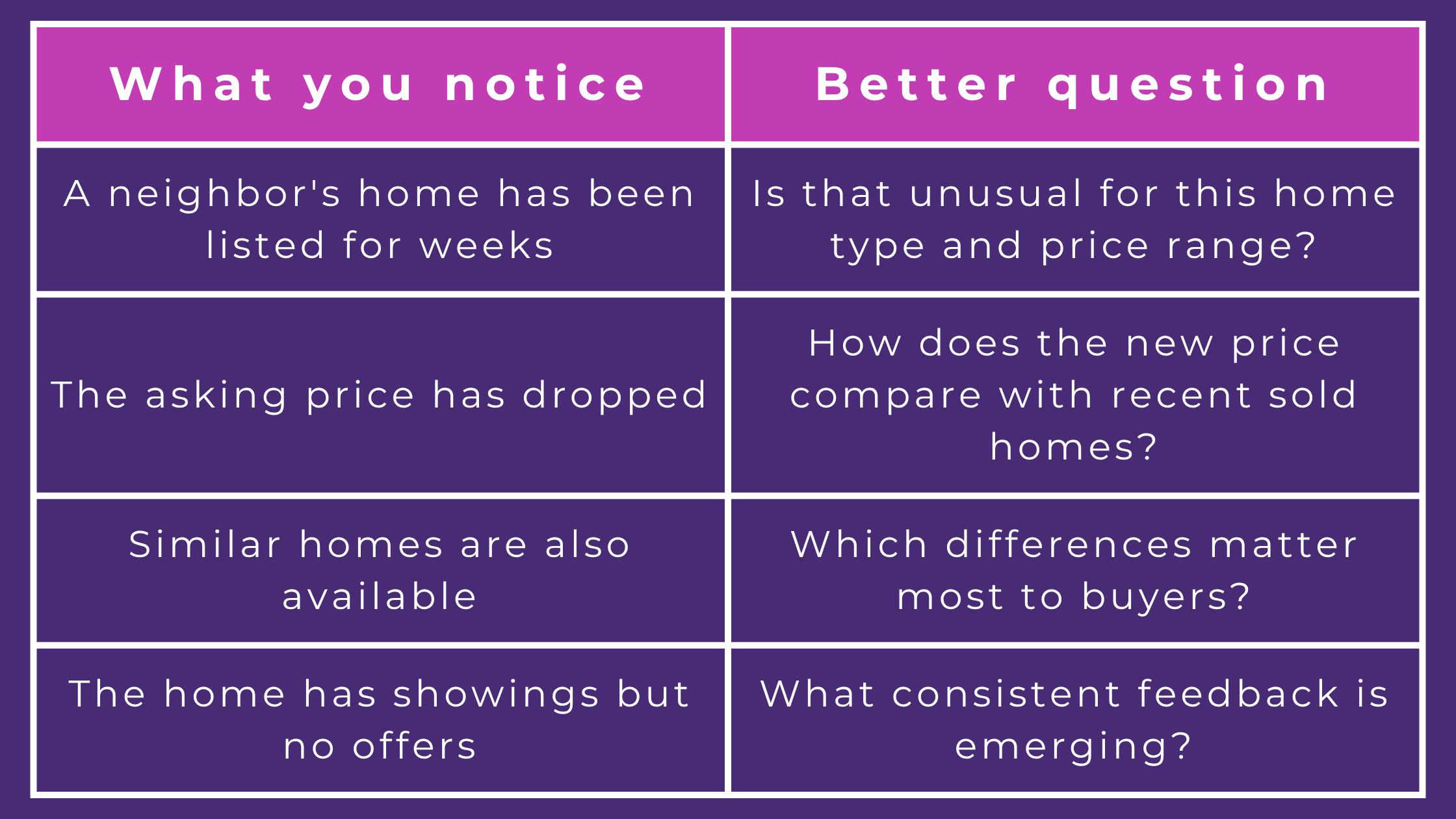
Is a home that's been listed longer a buying opportunity?
Possibly. A longer-listed property may be worth a closer look, and its seller may be open to discussing terms. But buyers should still review comparable sales, property condition, inspection findings, financing, and the total cost of ownership.
Days on market alone are not proof of a bargain.
Should you change your selling plans because a neighbor's home hasn't sold?
Not based on one listing. Review your own home's condition, the most relevant closed sales, current competing homes, estimated net proceeds, and timeline. A nearby listing is one data point—not a forecast.
If your home is already listed without the response you expected, see our related guidance on planning your home sale and ask for a property-specific review.
How do you find out what your own home could sell for?
Start with a comparative market analysis that explains the evidence behind a price range. Sarah Roberts and Ria Joy Wilds of Mosaic Realty Group have earned the Pricing Strategy Advisor certification, additional education in comparative market analysis and pricing conversations.
Wondering what the homes around you mean for your own plans? Start with Mosaic's home-value resource. We'll help you compare the properties that actually compete with yours and talk through your options.
By Sarah Roberts, Broker Associate | Mosaic Realty Group
A Note From Sarah

One home doesn't tell the whole market story.
We look at recent sales, current choices, and the details that make a property different. Whether you're thinking about selling or watching for your next home, we want you to understand the comparison before deciding what to do.
Helpful Resources for Your Next Step
Frequently Asked Questions About Homes Sitting on the Market
Why are houses sitting on the market in North Texas?
Price expectations, buyer comparisons, local competition, and affordability can all contribute. Condition, layout, timing, and showing access may also matter.
Does a price reduction mean something is wrong with a house?
No. It can reflect an adjustment to market conditions or a seller's plans. Investigate the home and its comparable sales rather than assuming.
Does more inventory always mean homes will take longer to sell?
No. Inventory differs by neighborhood, property type, and price range. Look at the homes a specific buyer would consider.
Should I price my house based on my neighbor's asking price?
No. A list price is not a completed sale. Review genuinely comparable closed sales and current competition.
Can buyers negotiate on a home that has been listed longer?
They can make an offer, but a seller's willingness depends on circumstances. Evaluate the property, price, and contract terms first.
